

The OG "mean boys" (of Athens)
Finally, some history I can remember c/o the Ancient Agora

At the recommendation of someone I can’t credit, I spent a happy several hours in January 2023 wandering the Ancient Agora in Athens. Sunshine warmed the chilly winter air, and I wandered where famous people like Socrates and Plato taught and socialized and philosophized and shopped. That was incredibly cool, and I was tickled to have the place largely to myself. Well, to myself, the groundskeepers, a few strolling couples. And cats.
Don’t get me wrong, I was seriously interested in the profound historicity of the place. I was additionally very interested in all the cats. If you’re going to be a homeless cat, one could do worse for locale than a temperate climate, generous tourists, and free reign of the historic ruins of “the birthplace of democracy.” And while these are technically run-of-the-mill felis catus, they are GREEK felis catus, and it’s not just everywhere a person sees so many free-range, polite cats. Hence my interest.
Obviously, not every Athenian cat resides in the Ancient Agora. Which makes me wonder if only the wisest felines are drawn here. Or, if their choice of residence is accidental, is the wisdom of ancient human philosophers somehow perpetuated among the cats walking where they walked? Whatever the situation, I found myself imaging that, as these cats wander about or lounge around, they are actually pondering the big questions of life. This one, let’s call him Antisthenes, is definitely meditating on asceticism at the entrance of an ancient temple.
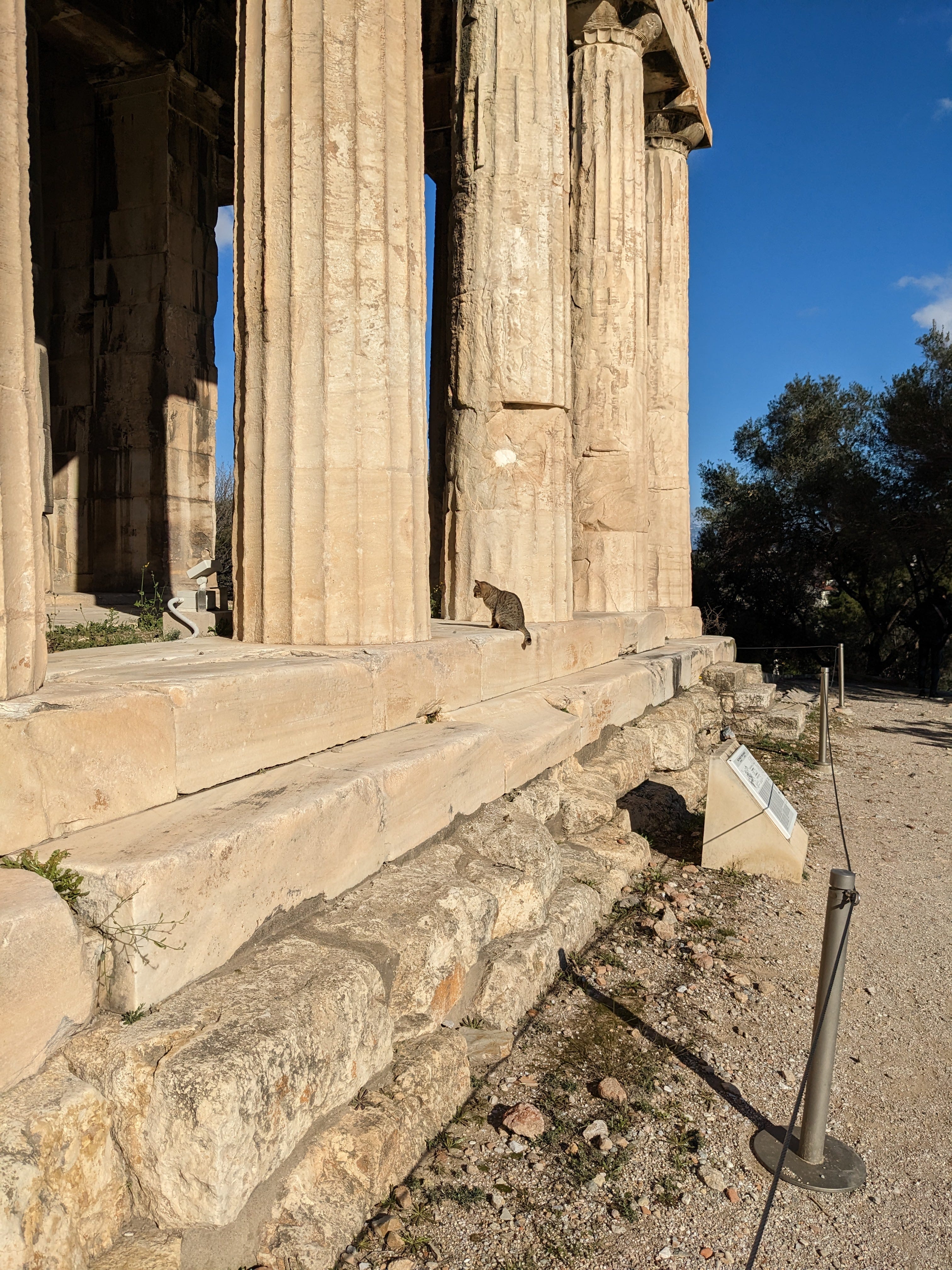
Paid subscribers: Scroll down to the bottom for access to a Google Photos album containing more pictures I took of the Agora. And more Greek cats.
After hours of wandering, reading signs, marveling at the profound significance of all that happened in this place, and of course watching cats, I decided to give the on-site museum a whirl. The Acropolis Museum—something I tried to skip but could not find a ticket that didn’t include the museum—had positively knocked my socks off and reconverted me to museums.
That said, I’ve long believed that, in museums, you can only appreciate so many baskets, tunics, and shards of household pottery. At some point they all start to look the same across cultures and centuries. If, however, those shards of pottery had been used to kill someone or dig a person’s way to freedom, my interest is suddenly piqued.
Regretfully, human nature seems to be interested in the very beautiful, the very eventful, and the very awful. I am unfortunately more interested in instruments of torture than I am in farming implements or tapestries. Things like the latter only interest me if they’re GINORMOUS, contain a secret message considered treasonous in its time, or someone made them under duress. Museums might fare better if they include a few more sensational exhibits and offer a map indicating which exhibits appeal most to our base human interests.
This said, I do understand that even the mundane parts of human history are worth preserving. I just ask that, if a centuries- or millenia-old museum artifact is not something worthy of the Dateline of its time, it please be either HUGE or small and really cute.


After snapping pictures and trying to get interested in the daily lives of ordinary Athenians as captured in several exhibits, I moved along and stopped when the word ostracism caught my eye. And boy, am I glad it did. Otherwise, I probably would’ve moved right along, assuming we were looking at boring shards of pottery. We were not.
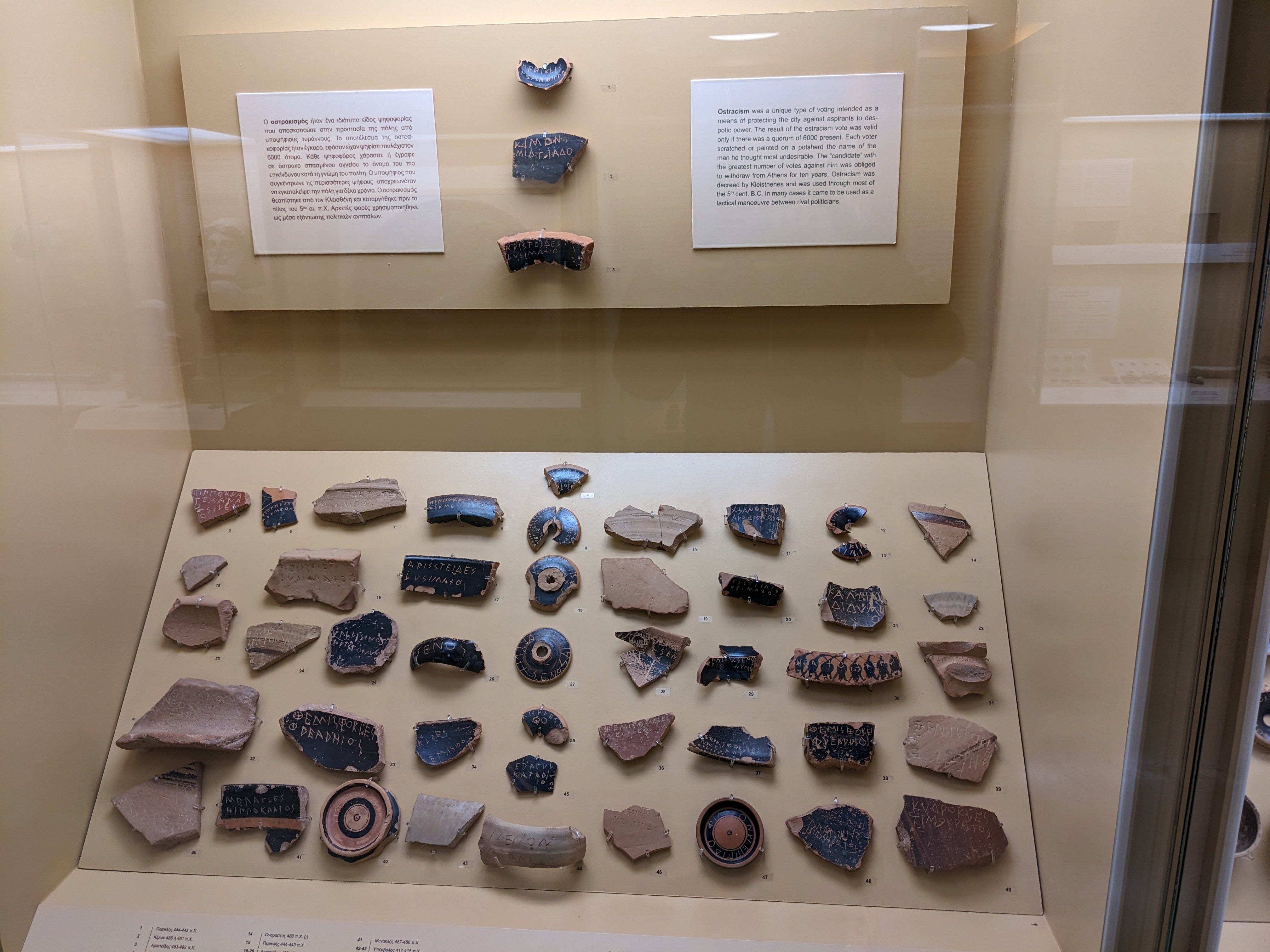
For your reading pleasure, I have hand-transcribed the text of the plaque:
Ostracism was a unique type of voting intended as a means of protecting the city against aspirants to despotic power. The result of the ostracism vote was valid only if there was a quorum of 6000 present. Each voter scratched or painted on a potsherd the name of the man he thought most undesirable. The “candidate” with the greatest number of votes against him was obliged to withdraw from Athens for ten years. Ostracism was decreed by Kleisthenens and was used through most of the 5th cent. B.C. In many cases it came to be used as a tactical manoeuvre between rival politicians.
Kicked out of town for TEN YEARS?!
Do we trust the plaque? I say yes, even while remembering the plaque my brother shared from an aquarium visit in India. There a plaque shared where each type of fish originated; it was news to all of us that Lion Fish come from Mississippi and Great White Sharks come from Missouri.
My initial research, however, confirms that ostracism was a real thing in Athens. I’m tempted to write my first researched book all about this fascinating practice. The list of questions includes, but is not limited to the follow:
Which men actually got ostracized?
Did their families go with them?
Could they visit Athens? “Hey guys, remember me? Yeah, I’m the one who won the vote seven years ago…”
Were they chased out of town immediately or did they have a grace period to pack?
Where did they go?
What was life like when/if they returned?
How nervous were they on the Athenian version of Reaping Day?
They SAY it was to protect the city from despots, but we could be looking at the ancient origins of the “mean girls” phenomenon. Kicking people out the group is as old as human history. To the first caveman who discovered the wonders of bathing, the others probably said—after complaining with each other that Chad now stunk of “clean”—“Oh sorry, Chad. Did we forget to tell you we were heading out on the wooly mammoth hunt? Super sorry about that.” (They weren’t.) It seems we’ve always had cliques that come up with reasons for kicking people out of the group. Maybe these OG mean boys were just the first to formalize it and make it sound so community-oriented.
In this recent piece, I shared that I don’t have the gift of memory for history. But it would appear I was wrong. As we’ve just seen, there are parts of history I can REALLY get into. Am I proud of the parts of history that I can remember for years? No. But someone has to remember these sort of sordid details, so I’ll keep at it. I’ll leave the appreciation of farming implements, baskets, and regular ol’ pottery to others who genuinely get excited about such things. My interest will apparently remain in the gutter with the more primal parts of history.
Isn’t life cool and aren’t people interesting—even when they kick neighbors out of town for a decade? See you in the next one…

For my paid readers, here is a link to more pictures from this memorable day. Enjoy!